
One in three workers, and a lot of long chats
According to Statistics Canada, 35.9% of workers aged 15 to 69 used generative AI tools at work in the 12 months leading up to March 2026, just over one in three. Among those users, 31.4% used them daily.
Used that often, AI chats become part of how work gets done: options weighed, drafts rewritten, choices made. The chat holds the reasoning. What it doesn't do is tell you, at a glance, what was actually decided.
A summary isn't a record of decisions
Asking the chat to "summarize this" gives you what it was about. Useful, but a team usually needs something else:
- What's decided: the choices that are settled.
- What changed along the way: the first plan and what replaced it, so nobody goes back to the old one.
- What was set aside: the options you dropped, and why.
- What doesn't add up: two messages that contradict each other, a number that changed without a reason.
That last one matters most. Long chats drift, and a decision made on Monday can be quietly undone on Thursday.
Write the memo by hand
- Write what the chat was about, in one or two lines.
- Go through the chat and list each decision, with the latest version winning.
- Note each change: "first X, then Y, because…".
- List what you dropped, with the reason in a few words.
- Flag what doesn't add up, and check it with whoever decides.
WHAT THIS IS ABOUT: [one or two lines]

WHAT'S DECIDED:
- [decision]

WHAT CHANGED ALONG THE WAY:
- [first version] → [what replaced it], because [reason]

WHAT WAS SET ASIDE:
- [option], because [reason]

WHAT DOESN'T ADD UP:
- [contradiction to check]
Check your workplace's rules first.
Many employers have rules on which AI tools you can use and what you can put in them, such as client names or personal information. Those rules apply to the chat before they apply to the memo.
The faster way: Memo, in Uncook
Going back through a long chat for every decision is the slow part. Uncook's Memo does it for you. On the ChatGPT page, click the Uncook icon and pick Memo. You get a clear document with what this is about, what's decided, what was set aside, what changed along the way and what doesn't add up.
See the tool box for task usage. You can set its language: handy when the chat was in English and the memo goes to a French-speaking team. Then copy it, export it to PDF, Markdown, text or Word, or share it as a page.
Did the work happen over several chats? Select them together: the memo shows where your chats agree, where they differ, and what's still open.
It works the same way for chats in Claude, Gemini, Perplexity, Mistral Vibe (ex-Le Chat), Gemini Notebook and Google AI Studio.
Before you send it
A memo is a starting point for the people who decide, not a decision in itself.
- Read it against the chat where it matters: a date, a number, a name.
- Settle what doesn't add up before you share it, or share it as an open question.
- Remove what shouldn't travel: anything your workplace's rules keep internal.
Questions people ask
What's the difference between a summary and a memo? A summary gives you the essentials of the chat. A memo is about decisions: what's settled, what changed, what was set aside and what doesn't add up.
Can I get the memo in French if the chat was in English? Yes. You can set the memo's language. Changing it runs Memo again, as a task.
Does Memo work on chats from Copilot? Yes, for Microsoft Copilot on copilot.microsoft.com, opened in Chrome, as well as ChatGPT, Claude, Gemini and the other AIs Uncook reads.
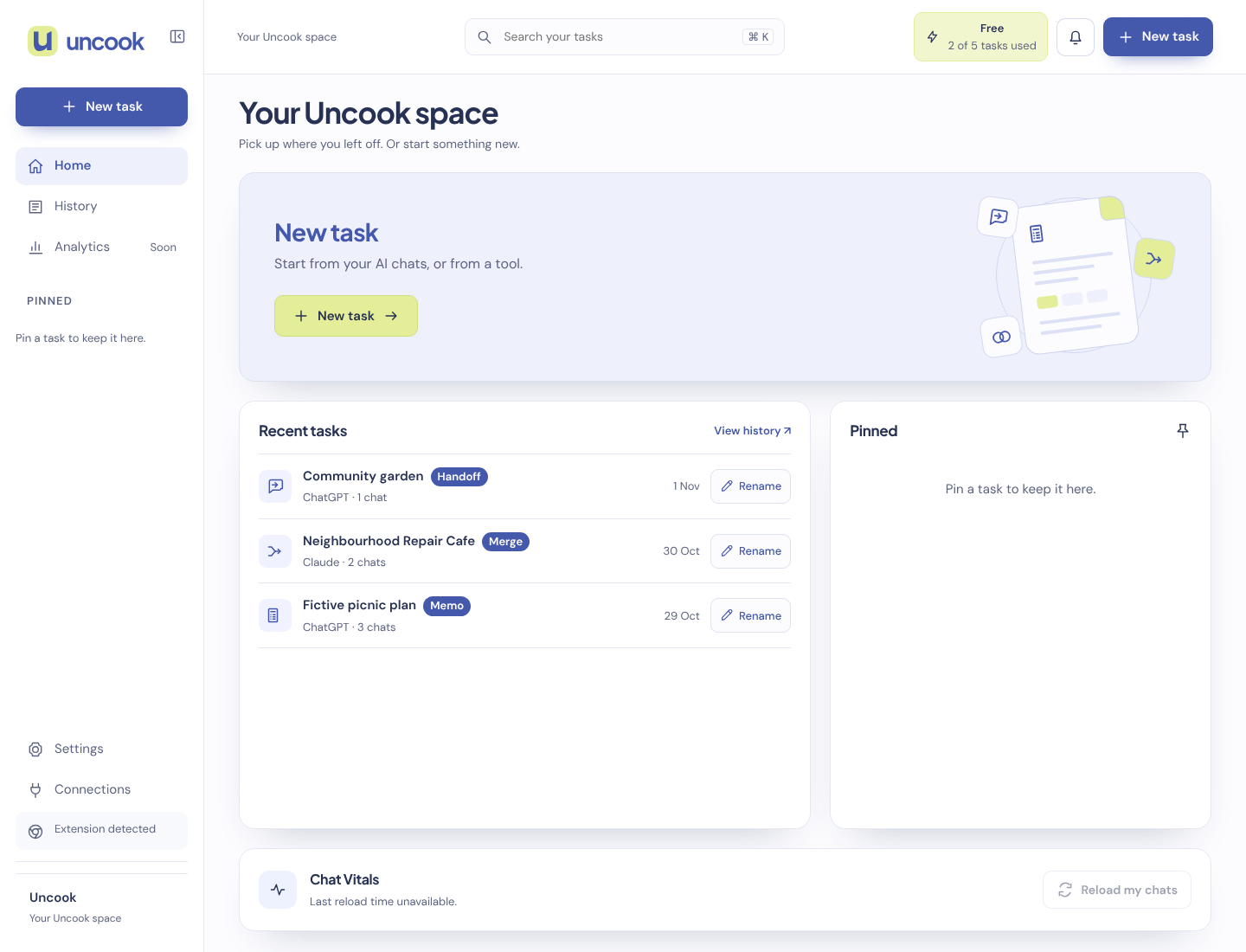
We don't keep the conversations you bring. When you click Send to Uncook in the extension window, the extension sends the chat from your tab to our servers, encrypted, for up to 30 minutes, and we delete it as soon as your Uncook page opens it. What Uncook makes from it is kept as a task, for as long as our Privacy page says. Neither your chats nor your tasks are used to train AI models.