
What "forgetting" looks like in a project chat
When a project chat gets long, you start to see things like:
- It brings back an approach you dropped weeks ago.
- It writes code for a different version, framework or database than the one you chose.
- It forgets your naming rules, or the format your guide wants.
- It asks again for something you already gave: the schema, the file names, the error you fixed.
- A reminder works for one reply, then it slips again.
Why long chats drift
An AI can only take in so much of a chat at once. Your setup, every message, every pasted file and every reply share that space. Early on there's room, and your rules stick. As the chat fills up with code, logs and back-and-forth, the earliest parts get less attention, or fall out of what the AI can see. That's usually your setup.
It isn't just a feeling. A 2025 study by researchers from Microsoft and Salesforce found that across six generation tasks in simulated, underspecified conversations, the models performed 39% worse on average when instructions arrived over several turns rather than together. This does not measure every long chat or establish that length alone causes the decline.
So the fix isn't to repeat your rules louder in the same chat. It's to start a fresh one with only what still counts.
A project chat carries its own history.
Every abandoned approach, every broken version of the code, is still in the chat. The AI can't tell which ones you threw away unless something tells it. A handoff does: it carries the decisions, not the drafts.
Restart with a project handoff
- Scroll the old chat and note the goal, the stack and versions, what's decided, the rules, and where you stopped.
- Leave out the dead ends. Old errors you fixed and approaches you dropped stay behind.
- Open a new chat and send the handoff first.
- Paste only the files you need now, not the whole history.
- Check it has the rules right, then carry on.
I'm continuing a project from an earlier chat. Here's what you need.

PROJECT: [what it is, in one or two sentences]

SETUP (don't change):
- [language, framework, versions]
- [database, folder structure, naming rules]

DECIDED (don't reopen):
- [decision 1]
- [decision 2]

DROPPED (don't suggest again):
- [approach we ruled out, and why]

WHERE WE ARE: [what works, what's in progress]
NEXT: [the next step]

Confirm the setup, then help me with the next step.
The faster way: Handoff, in Uncook
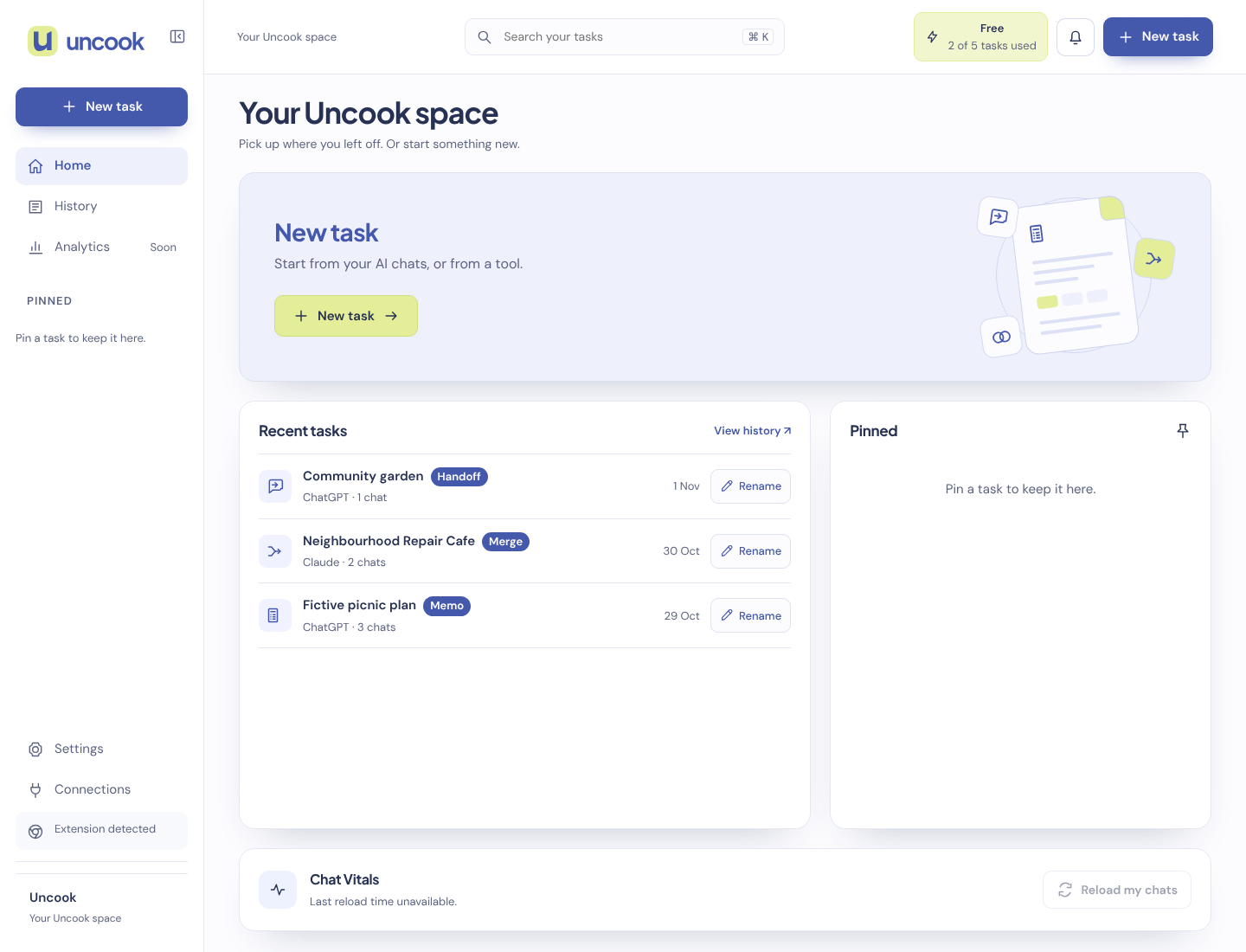
Going back through hundreds of messages to find your decisions is the slow part. Uncook's Handoff does it for you. On the ChatGPT page, click the Uncook icon and pick Handoff. You get the goal, what's decided, the rules you set and where you are, already written. Copy it into a new chat.
It works the same with a project chat in Claude or Gemini.
Keep your next project chat on track
- Put the setup in the first message: stack, versions, rules. Not scattered across replies.
- One part of the project, one chat. The database in one chat, the front end in another, the report in a third.
- Hand off early. When the chat starts suggesting things you ruled out, take it as the signal.
- Keep a log of what you decided. It helps the next chat, and it helps you when someone asks why: see how to keep a decision log for your final-year project.
Questions people ask
Does ChatGPT delete the start of my chat? No. The messages are still there when you scroll up. The problem is how much of a long chat the AI can take in when it answers.
Will a new chat lose the code we wrote? The code is in your files, not in the chat. Paste the parts you're working on into the new chat, with the handoff.
Is it any different in Claude or Gemini? Every AI has a limit on how much of a chat it can take in at once. Long project chats drift in all of them, and the same handoff works in each.
We don't keep the conversations you bring. When you click Send to Uncook in the extension window, the extension sends the chat from your tab to our servers, encrypted, for up to 30 minutes, and we delete it as soon as your Uncook page opens it. What Uncook makes from it is kept as a task, for as long as our Privacy page says. Neither your chats nor your tasks are used to train AI models.