
Why a project built with AI needs a log
The trouble is that chats are a poor record. Decisions are spread across many of them, often in two different AIs. The reason you dropped one approach is in a reply from three months ago. And a long chat drifts: it can bring back ideas you'd already ruled out (why that happens).
A log keeps the decisions in one place, in your own words, where you can find them.
What goes in a decision log
Keep it short. For each stage of the project:
- What you decided: the topic, the stack, the dataset, the method.
- Why: the reason you'd give your guide.
- What you set aside, and why. You may be asked about the alternatives.
- What changed along the way: the approach you switched from, and when.
- What doesn't add up yet: two chats that say different things, a result you haven't explained.
The work stays yours.
A log records what you decided and why. It doesn't write the project for you. Follow your college's rules on AI use, and if your college asks you to declare how you used AI, a log of your decisions makes that much easier to do honestly.
Write it by hand
- List your chats: every ChatGPT and Claude chat about the project.
- Go through them one by one and note each decision, with a line on why.
- Mark what you dropped and what replaced it.
- Note the contradictions: where one chat says one thing and another says something else.
- Keep it in one file, dated, and update it after each working session.
PROJECT DECISION LOG  ([project name], updated [date])

DECIDED
- [decision], because [reason]  (chat: [where])

SET ASIDE
- [approach], dropped because [reason]

CHANGED ALONG THE WAY
- [from what] to [what], on [date], because [reason]

STILL OPEN
- [question], [what you need to settle it]
It works, but going back through months of chats takes an evening, and it's easy to miss a decision made in passing.
The faster way: Memo, in Uncook
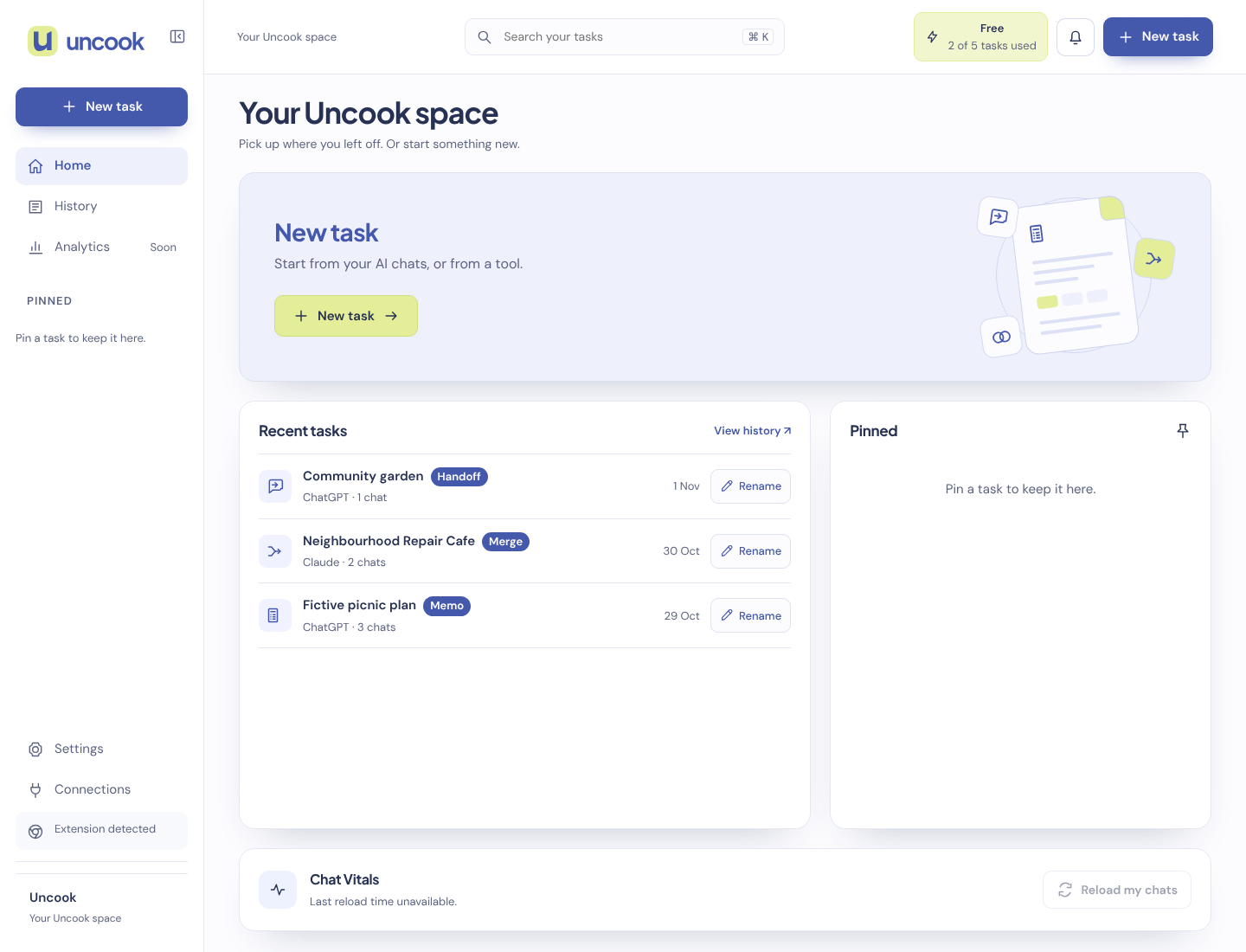
Uncook's Memo reads a chat and writes that log for you. Open the chat in ChatGPT or Claude, click the Uncook icon and pick Memo. On one chat, you get what it's about, what's decided, what was set aside, what changed along the way and what doesn't add up.
On several chats at once, Memo shows where they agree, where they differ and what's still open: useful when the database chat and the report chat no longer match. Check the account limits in the tool box below.
Read it against your chats before you rely on it: it's your log, and you'll be the one explaining it.
Using the log for your report and viva
- The report. If your report has a methodology or design choices section, your decision log is its first draft.
- The viva. Read the "set aside" list before you go in. "Why didn't you use X?" is the kind of question it answers.
- Your next chat. Paste the log at the top of a new chat, so the AI starts from your decisions instead of guessing.
Questions people ask
Can I keep one log for chats in ChatGPT and Claude? Yes. Uncook reads chats from both, and from 6 other AIs. Make a Memo of each, or of several together, and keep them in one file.
Can I export the log? Yes. Copy it, or export it as PDF, Markdown, text or Word.
Is a Memo enough to declare my AI use? It records your decisions, not every prompt. Check what your college asks for. If it wants the chats themselves, Export saves a chat as PDF, Markdown or text.
We don't keep the conversations you bring. When you click Send to Uncook in the extension window, the extension sends the chat from your tab to our servers, encrypted, for up to 30 minutes, and we delete it as soon as your Uncook page opens it. What Uncook makes from it is kept as a task, for as long as our Privacy page says. Neither your chats nor your tasks are used to train AI models.